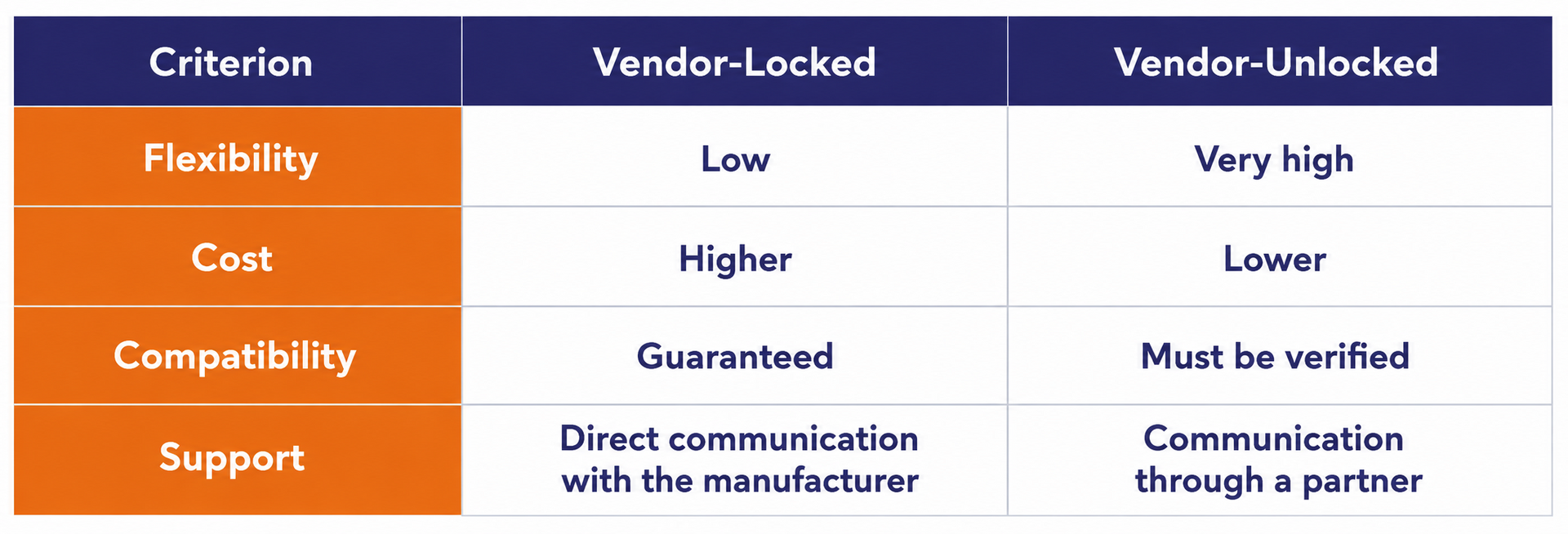



Vendor-locked and vendor-unlocked technologies represent two fundamentally different approaches to designing a server environment. The former is built around the stability and unified ecosystem of a single manufacturer, while the latter offers greater flexibility and the ability to optimize hardware for a specific workload. At ANAFRA, we assess this question individually, based on the needs of each infrastructure. We do not favor one approach over the other, nor one manufacturer over its competitors. Our goal is always to design a solution that makes sense for the specific customer. In this article, we therefore examine the benefits and risks of both approaches and highlight the situations in which a vendor-locked solution may be preferable and those in which an open, vendor-unlocked infrastructure makes more sense.
When building on-premises server infrastructure, IT architects face a strategic decision that will shape operations for years to come: should they commit to a homogeneous ecosystem from a single manufacturer, or choose an open architecture that combines components from multiple vendors?
There is no universal answer. We have therefore analyzed both paths by considering actual costs, operational risks, and flexibility, helping you determine whether the easy “vendor lock-in” is the better choice or whether investing in independent infrastructure will deliver greater value. The strategy you choose has a major impact not only on acquisition costs but also on the stability, security, and long-term flexibility of the entire system.
Let us take a closer look at the advantages and disadvantages of each option and outline the types of organizations for which they may be suitable.
Vendor-locked strategy (single-vendor)
With this strategy, you purchase all servers from a single manufacturer (such as Dell/HPE/Lenovo), including all components—chassis, motherboards, power supplies, and management tools. The result is a homogeneous infrastructure.
This option is worth considering for organizations that prioritize certainty, stable support, and long-term continuity. It is generally suitable for large corporations, banks, and public-sector institutions where availability and performance are critical, as well as smaller companies with limited IT capacity to manage a heterogeneous environment.
Advantages
- A single support and SLA contact — when assistance is required, you deal with one point of contact that understands the entire environment. Unified warranties and service agreements (such as NBD support) simplify incident resolution and speed up support.
- Guaranteed component compatibility — all components are designed and tested to work together seamlessly from the moment they are installed. Firmware across all components is tested as a complete system, minimizing the risk of crashes.
- Unified management — centralized infrastructure administration with consistent tools for monitoring, updates, and maintenance. With proactive diagnostics — often referred to as call-home functionality — the server can automatically report critical conditions directly to the manufacturer.
- Commercial advantages — for larger volumes, it is often possible to negotiate better pricing or more favorable service agreements.
Disadvantages
- Higher acquisition cost — you are paying not only for the hardware but also for the brand, service infrastructure, and the “guarantee” that every component will operate without issues.
- Dependence on a single manufacturer (vendor lock-in risk) — changing suppliers can be complex and costly. You may become trapped by unavailable components, excessive pricing, or the discontinuation of support for a particular product line.
- Limited configuration options — you can choose only from components that the manufacturer has tested and included in its catalog.
- Less room for innovation — you are dependent on the manufacturer’s development pace.
- Potential mismatch with individual needs and requirements — the solution cannot be further customized or expanded beyond the approved components.
Vendor-unlocked strategy (multi-vendor)
This approach allows you to combine hardware from different vendors, such as ASUS, ASRock Rack, GIGABYTE, and MiTAC. The result is a heterogeneous infrastructure in which you can select the technology best suited to each specific task — a “best-of-breed” approach.
Different parts of the infrastructure can also be combined flexibly—for example, servers from one manufacturer, storage from another, and network infrastructure from a third.
A multi-vendor strategy is better suited to organizations that need to innovate quickly or test new technologies and that place a high priority on flexibility. It is typically used by startups and scale-ups, research institutions, and cloud providers that want to customize and standardize hardware themselves, as well as companies with highly skilled IT teams capable of managing diverse hardware platforms.
Advantages
- Maximum flexibility and freedom of choice — no single manufacturer dictates which components you must use. Hardware can be combined freely, and suppliers can be changed or workloads migrated more easily when needed.
- Independence — the risk of lock-in is significantly lower. You are not tied to a single compatible part number because multiple alternatives are usually available. Individual components can also be replaced without having to change the entire rack or ecosystem.
- Cost efficiency — lower acquisition costs and the ability to respond flexibly to changing market prices for individual components.
- Hardware optimization for a specific purpose — servers can be designed precisely around the specific requirements and unique needs of a particular environment or application.
- Faster access to innovation — new technologies can be deployed before major manufacturers incorporate them into their closed ecosystems.
Disadvantages
- Risk of incompatibility — careful validation is required to ensure that different components, such as a specific PCIe card in a particular slot, work together reliably.
- More complex troubleshooting — when an issue occurs, the specific component causing it must be identified, which can extend the diagnostic process.
- Multiple support contacts — during an incident, it may be more difficult to determine whom to contact. This can also lead to finger-pointing, with individual vendors shifting responsibility to one another.
- Fragmented management — different components may require separate tools for monitoring, administration, or updates.
- Greater demands on the internal IT team — managing a heterogeneous infrastructure requires more experienced administrators who can work across multiple platforms and technologies.

Hybrid strategy (complete systems)
There is also a middle ground, currently represented by manufacturers such as Supermicro. This model sits between the traditional vendor-locked and vendor-unlocked strategies and combines the advantages of both. The infrastructure is based on a unified server platform from one manufacturer — such as the chassis, motherboards, or management layer — while individual components remain relatively open and can be selected according to the specific needs of the environment.
In this model, the server is assembled from individual components (processors, memory, drives, accelerators, network cards, or storage modules) that can be combined with a relatively high degree of freedom. Third-party components may also be used, although doing so may void the manufacturer’s warranty.
This approach is a suitable choice when you want to retain the stability and straightforward management of the core server ecosystem while also optimizing cost or performance in specific parts of the infrastructure, such as GPU acceleration, storage, or networking.
Flexibility Requires Thoughtful Architecture
Open approaches place significantly greater demands on architectural design and rigorous component compatibility testing. Selecting the right combination of processors, memory, add-in cards, drives, and firmware versions requires experience and a systematic approach. Otherwise, the benefits of an open architecture can quickly turn into operational complications.
This is why an experienced systems integrator often plays a key role in such projects, ensuring that individual technologies are properly designed, tested, and supported for long-term operational stability.
The Right Partner Matters More Than the Brand
At ANAFRA, we can provide customers with both standardized enterprise platforms and open, flexible configurations wherever they make more sense. We design, assemble, and burn-test vendor-unlocked servers ourselves and provide comprehensive support, including our own NBD warranties.
Alongside branded servers, we can therefore design systems built from individual components that precisely match the customer’s requirements and are optimized for their specific needs.
We provide service and support throughout Central Europe — in the Czech Republic, Poland, Germany, Austria, Slovakia, and Hungary. Our goal is not to sell a particular brand, but to design infrastructure that genuinely meets your requirements and gives you long-term operational confidence.